Personality and responses to AI oversight
How do responses to AI monitoring and incentives vary with personality, and what happens to honesty after rewards or feedback are withdrawn?
Published 2026
- Journal
- Acta Psychologica Sinica
I helped design the experiments, programmed the PsychoPy tasks, and analyzed trial-level responses with mixed-effects models in Python and R.
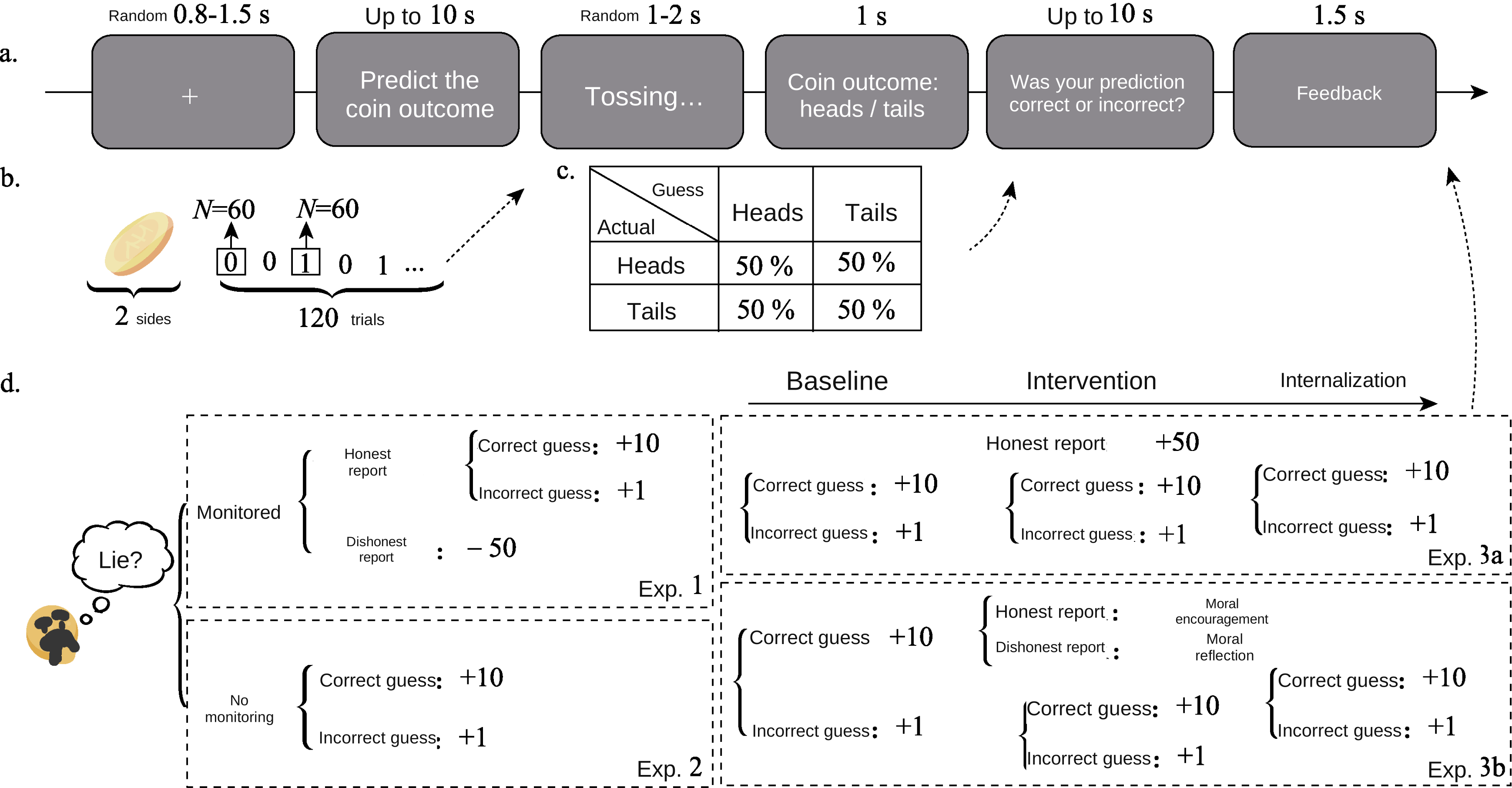
A coin-prediction task across four experiments
 Opens in a new tab.
Programmed monitoring and feedback were framed as AI oversight. In Experiment 3a, an unannounced extra reward followed five consecutive honest reports; Experiment 3b used encouraging or reflective text.
Visible monitoring produced the highest honesty
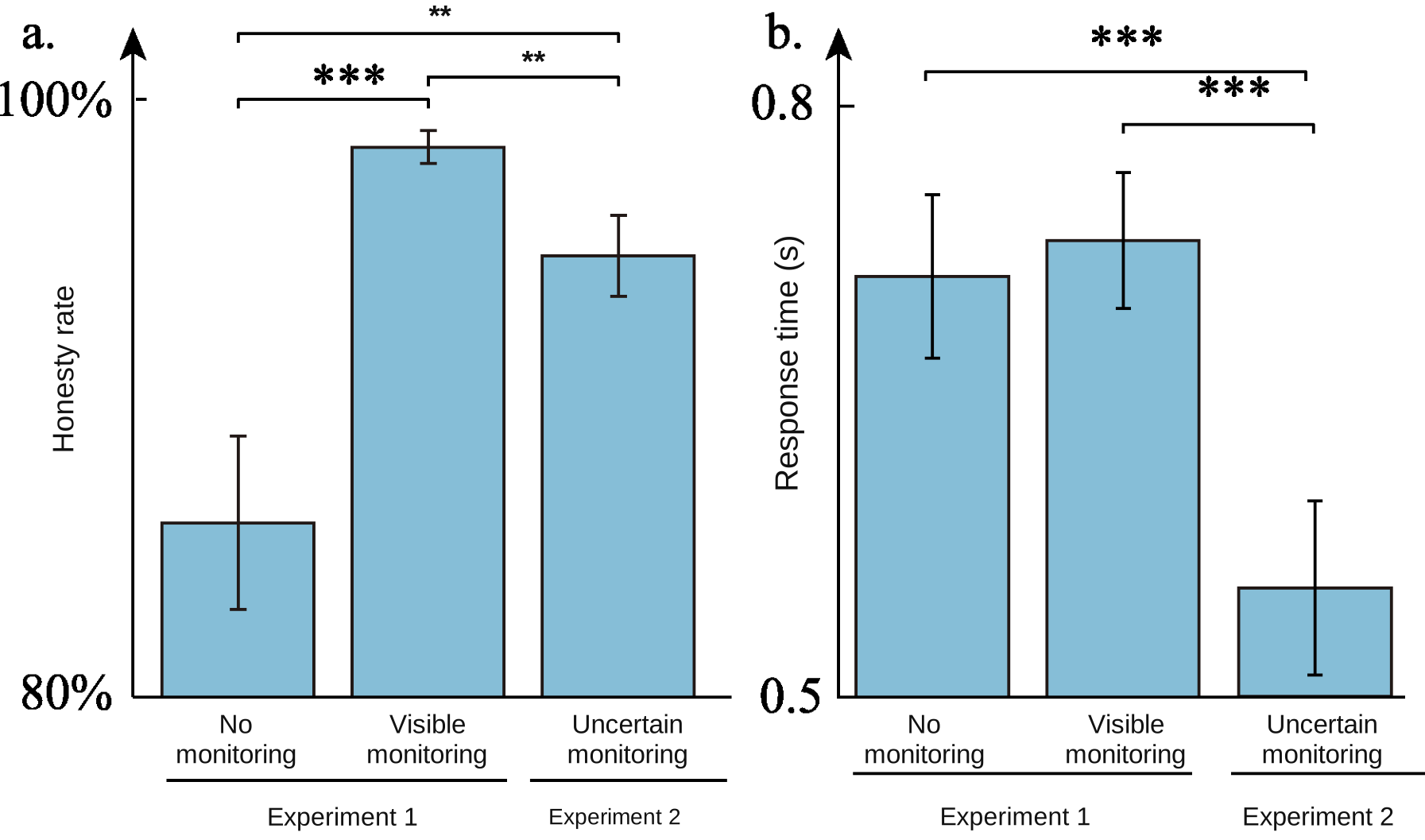
Honesty was highest under visible monitoring, intermediate when monitoring was uncertain, and lowest without monitoring. The same 46 participants completed Experiment 2 after Experiment 1; uncertain monitoring meant knowing that oversight was possible without seeing its current status.
 Opens in a new tab.
| Comparison | Honesty rate | Response time |
|---|---|---|
| Visible vs no monitoring | 98% > 85%; p < .001 | 0.64 vs 0.63 s; not significant (post-hoc p = 1.00) |
| Uncertain vs no monitoring | 94% > 85%; p = .001 | 0.49 < 0.63 s; p < .001 |
| Visible vs uncertain | 98% > 94%; p = .001 | 0.64 > 0.49 s; p < .001 |
The Experiment 1 paired test likewise found no response-time difference between visible and absent monitoring (p = .383). In that experiment, behavior type, monitoring and their interaction also had no significant response-time effects (all p > .20).
Personality shaped monitoring responses
The honesty benefit of visible monitoring differed between high and low Machiavellianism groups (interaction p = .011) and psychopathy groups (p = .039), but not narcissism groups (p = .148). High and low refer to median splits of SD3 trait scores.
| Trait group | Honesty comparison | Reported p |
|---|---|---|
| High Machiavellianism | 98% > 79% | .005 |
| Low Machiavellianism | 99% vs 95%; not significant | .092 |
| High psychopathy | 99% > 82% | < .001 |
| Low psychopathy | 99% vs 94%; not significant | .091 |
Narcissism and the time taken to lie
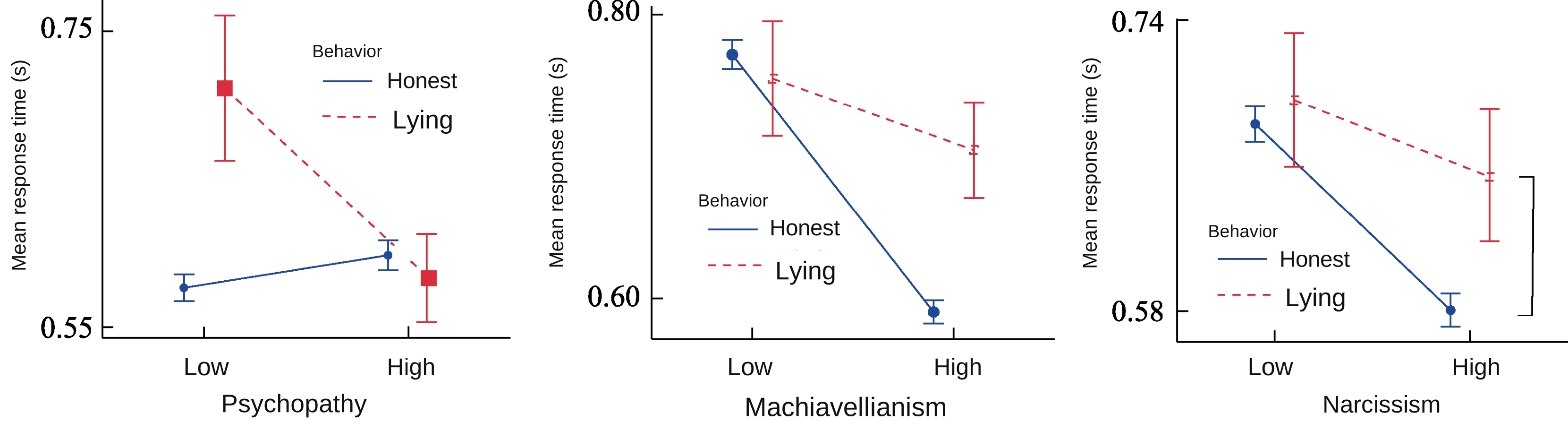
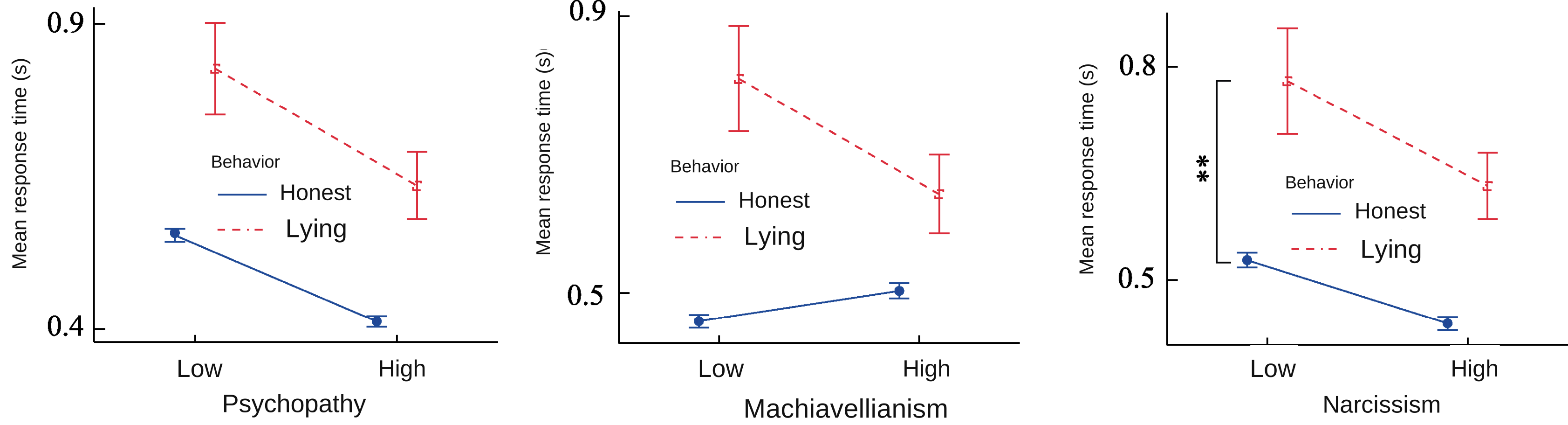
Behavior-by-narcissism interactions appeared in Experiment 1 (p = .030) and under uncertain monitoring in Experiment 2 (p = .038). Their simple comparisons differed: the clearest lying-time cost under uncertain monitoring occurred in the low-narcissism group.
 Opens in a new tab.
 Opens in a new tab.
| Experiment and group | Lying vs honest response time | Reported p |
|---|---|---|
| Experiment 1 · high narcissism | 0.65 vs 0.58 s; not significant | .0523 |
| Experiment 1 · low narcissism | 0.70 vs 0.68 s; not significant | .728 |
| Uncertain monitoring · high narcissism | 0.59 vs 0.48 s; not significant | .232 |
| Uncertain monitoring · low narcissism | 1.17 > 0.57 s | .004 |
In the Experiment 2 response-time analysis, lying was slower than honest reporting (0.92 vs 0.53 s, p = .002). Machiavellianism and psychopathy did not significantly moderate this time difference (interaction p = .344 and .842). Their behavior, trait-group and interaction effects were also nonsignificant in Experiment 1 (all p > .05).
Monetary rewards left a partial benefit after withdrawal
Separate groups received monetary incentives (Experiment 3a, n = 60) or moral feedback (3b, n = 62). Monetary rewards increased honesty; some of that gain remained after the reward was removed. Moral feedback showed no significant overall phase effect (p = .319).
Baseline, intervention and withdrawal occurred within one session. The paper calls withdrawal the “internalization” phase; it tests immediate persistence after feedback removal.
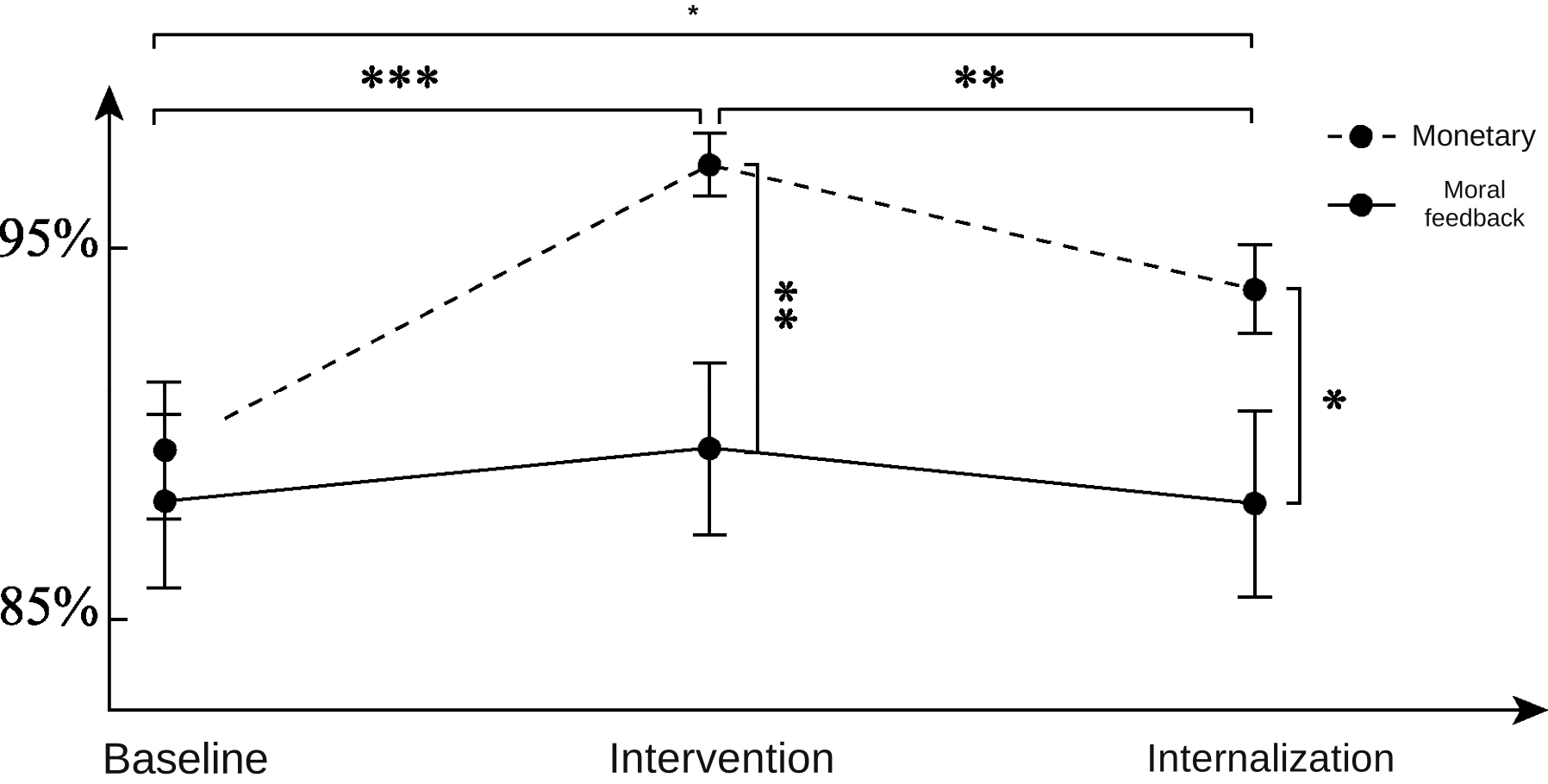 Opens in a new tab.
| Comparison | Honesty rate | Reported p |
|---|---|---|
| Intervention vs baseline | 97% > 89% | < .001 |
| Intervention vs withdrawal | 97% > 93% | .004 |
| Withdrawal vs baseline | 93% > 89% | .013 |
| Phase | Honesty rate: monetary vs moral | Reported p |
|---|---|---|
| Baseline | 89% vs 88%; not significant | .646 |
| Intervention | 97% > 89% | .003 |
| Withdrawal | 93% > 88% | .041 |
| Phase comparison | Monetary rewards | Moral feedback |
|---|---|---|
| Baseline vs intervention | 5.44 > 5.03 s; p < .001 | 5.63 > 5.07 s; p < .001 |
| Intervention vs withdrawal | 5.03 > 4.57 s; p < .001 | 5.07 > 4.45 s; p < .001 |
| Baseline vs withdrawal | 5.44 > 4.57 s; p < .001 | 5.63 > 4.45 s; p < .001 |
Trait differences persisted beyond the average effect
After monetary rewards were withdrawn, the high-Machiavellianism group was less honest than the low group (92% vs 96%, p = .044). Under moral feedback, high-narcissism participants had lower honesty at baseline, during feedback and after withdrawal.
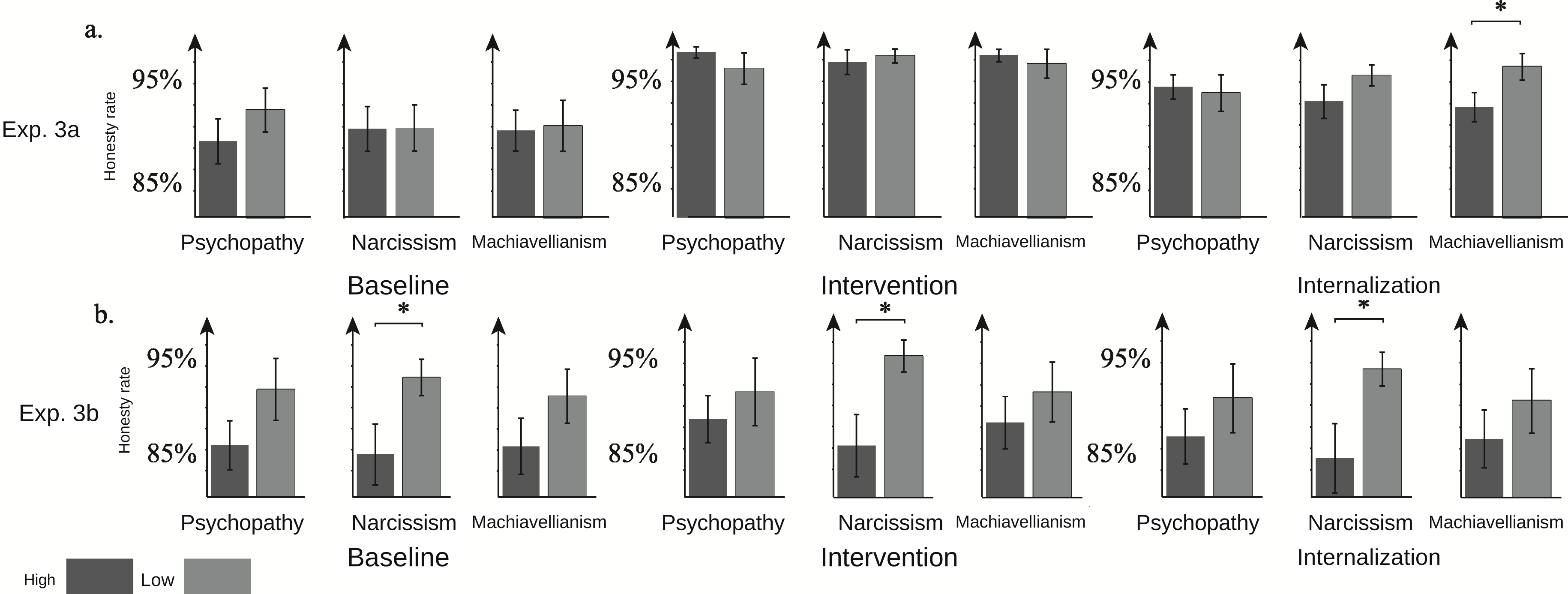 Opens in a new tab.
| Phase | Monetary rewards | Moral feedback |
|---|---|---|
| Baseline | No significant high–low contrast for any trait | High narcissism < low; p = .034 |
| Intervention | No significant high–low contrast for any trait | High narcissism < low; p = .013 |
| Withdrawal | High Machiavellianism < low; p = .044. Other traits not significant | High narcissism < low; p = .024 |
Under moral feedback, Machiavellianism and psychopathy high–low comparisons were nonsignificant at every phase (all p > .20 and p > .162, respectively). The monetary-withdrawal result compares groups at that phase; it is not itself a test of which group declined more.
Trial-level models connected traits with context
Mixed-effects models used continuous standardized trait scores and participant random intercepts. The forest plots show conditional model coefficients; the adjoining curves show model predictions.
Monitoring presence and visibility
Monitoring and visibility interacted (p < .001). Visibility also interacted with Machiavellianism (p = .013) and narcissism (p = .006), but not psychopathy (p = .445). The visibility-by-narcissism relationship additionally depended on whether monitoring was present (three-way p = .024); the corresponding Machiavellianism and psychopathy three-way terms were nonsignificant (both p > .5).
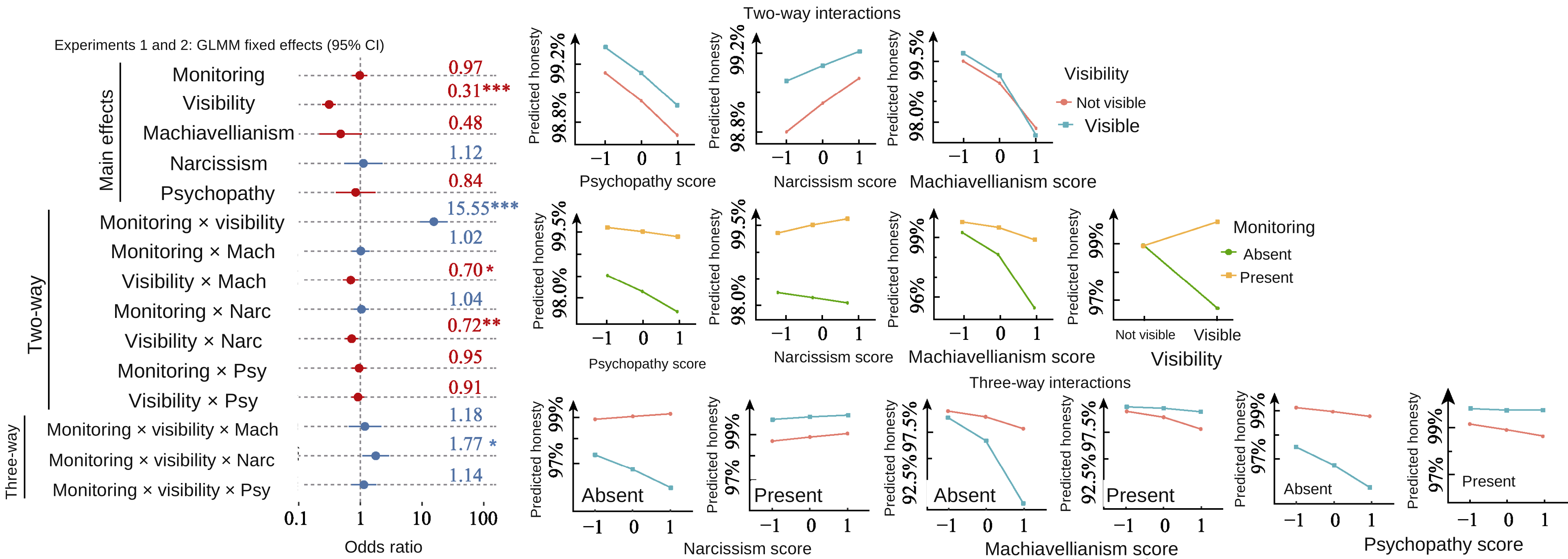 Opens in a new tab.
Feedback type, phase and personality
The monetary condition showed larger intervention and withdrawal-related honesty gains than moral feedback (type-by-phase p < .001 for both). Psychopathy was associated with stronger phase-related gains in the monetary reference condition (intervention p = .025; withdrawal p < .001).
As Machiavellianism increased, the relative withdrawal-stage change became more favorable to moral feedback (type × withdrawal × trait, p < .001). During intervention, the corresponding relative change favored monetary rewards at higher psychopathy scores (p = .025). These are interactions across conditions and phases, rather than separate within-group tests.
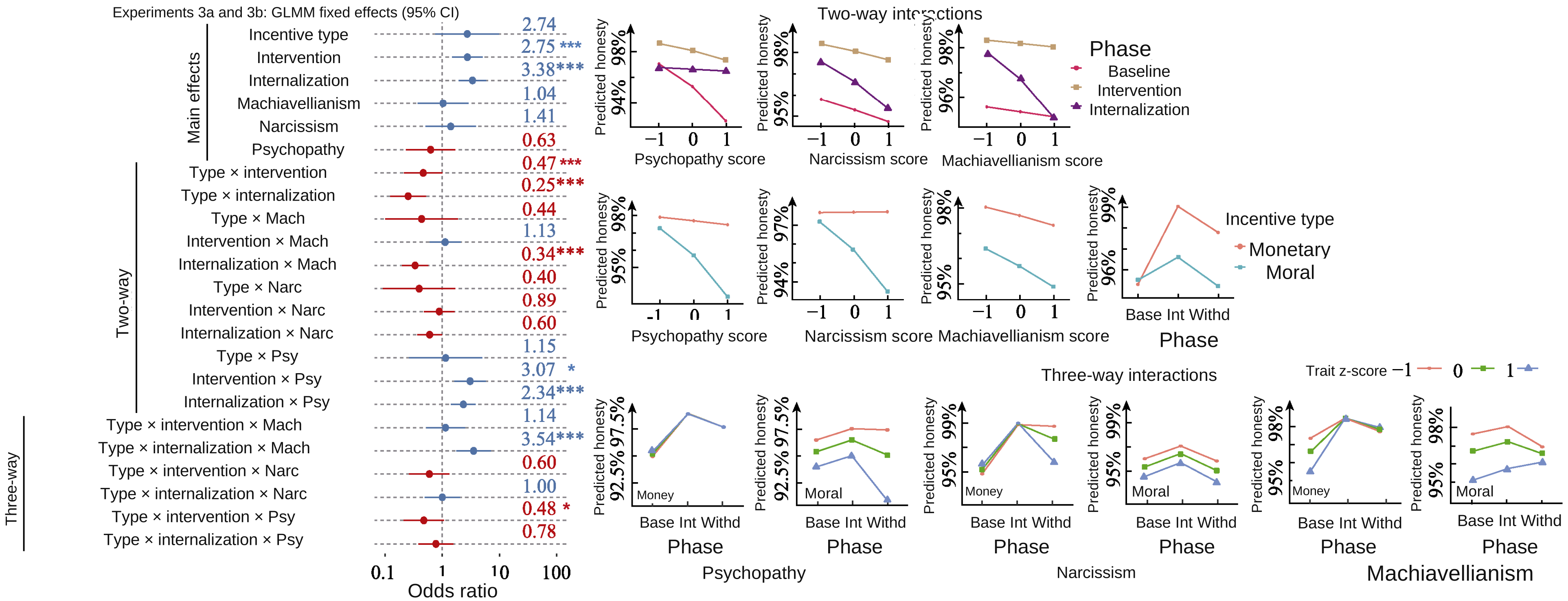 Opens in a new tab.
Reported statistical tests and effect sizes
Monitoring and personality
Experiment 1 honesty: t(45) = 4.59, p < .001, d = .67. Across the three monitoring conditions, honesty F(2, 90) = 18.10, η² = .28, and response time F(2, 90) = 34.10, η² = .43 (both p < .001).
In the three-condition post-hoc analysis, the honesty contrasts had t(45) = −4.60, −3.79 and 3.91, with d = .89, .58 and .54 for visible versus absent, uncertain versus absent and visible versus uncertain monitoring, respectively. Response-time contrasts had t(45) = 6.48, 6.20 and −.88, with d = .82, .71 and .06 for visible versus uncertain, absent versus uncertain and visible versus absent monitoring.
- Machiavellianism: honesty trait-group F(1, 44) = 7.81, p = .008, η² = .15; monitoring F = 24.01, p < .001, η² = .35; interaction F = 7.11, p = .011, η² = .14.
- Narcissism: honesty trait-group F(1, 44) = 1.10, p = .301, η² = .02; monitoring F = 21.69, p < .001, η² = .33; interaction F = 2.17, p = .148, η² = .05.
- Psychopathy: honesty trait-group F(1, 44) = 3.82, p = .057, η² = .08; monitoring F = 22.78, p < .001, η² = .34; interaction F = 4.50, p = .039, η² = .09.
The four within-group monitoring contrasts in Table 2 had t = 4.60 (df = 25), 1.77 (19), 4.44 (28) and 1.80 (16), with d = .90, .40, .82 and .44 for high/low Machiavellianism and high/low psychopathy, respectively.
The behavior-by-narcissism response-time interactions were F(1, 23) = 5.33, p = .030, η² = .19 in Experiment 1, and F(1, 29) = 4.74, p = .038, η² = .14 in Experiment 2. Under uncertain monitoring, the overall honest–lying contrast was t(30) = −3.34, p = .002, d = −.60; the low-narcissism contrast was t(17) = −3.33, p = .004.
In Experiment 2, Machiavellianism group, behavior and interaction tests were F(1, 29) = .31, 11.14 and .92 (p = .590, .002 and .344). Psychopathy tests were F(1, 29) = .30, 10.81 and .041 (p = .586, .003 and .842). Behavioral effect sizes were η² = .28 and .27, respectively.
Incentives and withdrawal
Monetary incentives: honesty F(2, 118) = 16.06, p < .001, η² = .21; response time F(2, 118) = 58.59, p < .001, η² = .49. Moral feedback: the reported honesty phase effect was nonsignificant (p = .319); response time F(2, 122) = 130.07, p < .001, η² = .68.
The combined analysis reported a phase effect, F(2, 240) = 13.30, p < .001, η² = .099, a feedback-type effect with p = .057, and a phase-by-type interaction with p = .0013. Between-type baseline, intervention and withdrawal contrasts were t(120) = .46, 3.07 and 2.06; the latter two had d = .55 and .34.
The monetary-withdrawal Machiavellianism contrast was t(57.98) = −2.04, p = .044, d = −.52. Under moral feedback, high–low narcissism contrasts were t(53.62) = −2.16, d = −.51 at baseline; t(49.95) = −2.55, d = −.60 during intervention; and t(48.52) = −2.31, d = −.54 after withdrawal.
Conditional model effects
In the monitoring model, the conditional monitoring main effect was nonsignificant (p = .838), visibility was significant (p < .001), and Machiavellianism had p = .065. The remaining conditional coefficients are shown in Figure 7. These coefficients are interpreted with their interaction terms, not as unconditional comparisons of monitoring conditions.
In the incentive model, intervention and withdrawal coefficients were positive (both p < .001), while feedback-type and trait main effects were nonsignificant (p = .892 and all p > .1). Figure 10 retains the other reported terms and their confidence intervals; exact unreported p values are not inferred from their size.
Measurement, materials pretest and model checks
The 27-item Short Dark Triad scale measured Machiavellianism, narcissism and psychopathy, with nine items per trait. Reported λ6 coefficients were .75, .70 and .72; KMO values were .80, .674 and .78; all Bartlett tests had p < .001.
An independent pretest with 111 participants checked the moral-feedback materials. Encouraging messages had more positive valence than reflective messages (7.88 vs 4.86; t(110) = 18.91, p < .001, d = 1.79). Ratings of encouragement to remain honest (7.47) and prompts to reflect (6.45) each exceeded the neutral midpoint of 5: t(110) = 24.02 and 12.76, d = 2.28 and 1.21 (both p < .001). These were material ratings, distinct from the behavioral outcomes.
The monitoring model had marginal/conditional R² = .19/.66, random-intercept variance = 4.58 and ICC = .58. The incentive model had marginal/conditional R² = .116/.517 and ICC = .45. Trait correlations were .07/.26/.28 in the monitoring data and .29/.46/.36 in the incentive data; reported VIFs were 1.15/1.26/1.09. These are model-fit and collinearity summaries, not out-of-sample prediction scores.
Publication
Wang, J., Jiang, X., Chen, Y., Wang, M., & Du, F. (2026). From Overt Deterrence to Covert Internalization: Moral Effects of AI Regulation and the Moderating Role of Personality Traits. Acta Psychologica Sinica, 58(3), 381–398.