Predicting decisions in human–agent dialogue
How well do language models predict people’s choices from their words and past behavior, across agent personas and user personalities?
Preprint · Submitted
- Dataset
- Personality-1260
- Evaluation
- 8 LLM predictors
I contributed to the design and psychological grounding of user profiles, considering how past behavior, personality and interaction partners inform the interpretation of what people say.
 Opens in a new tab.
From recorded games to offline forecasts
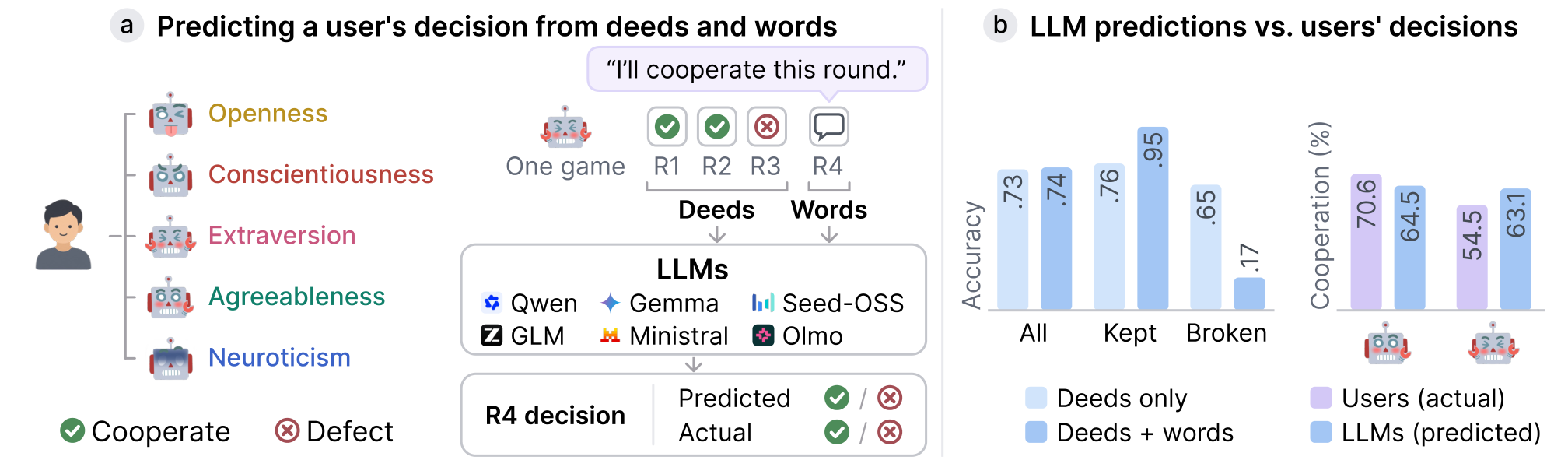
The study reused Personality-1260: 42 participants played six rounds with each of five agents prompted to express different Big Five traits. They could talk before choosing to cooperate or defect. Both players’ choices determined the rewards.
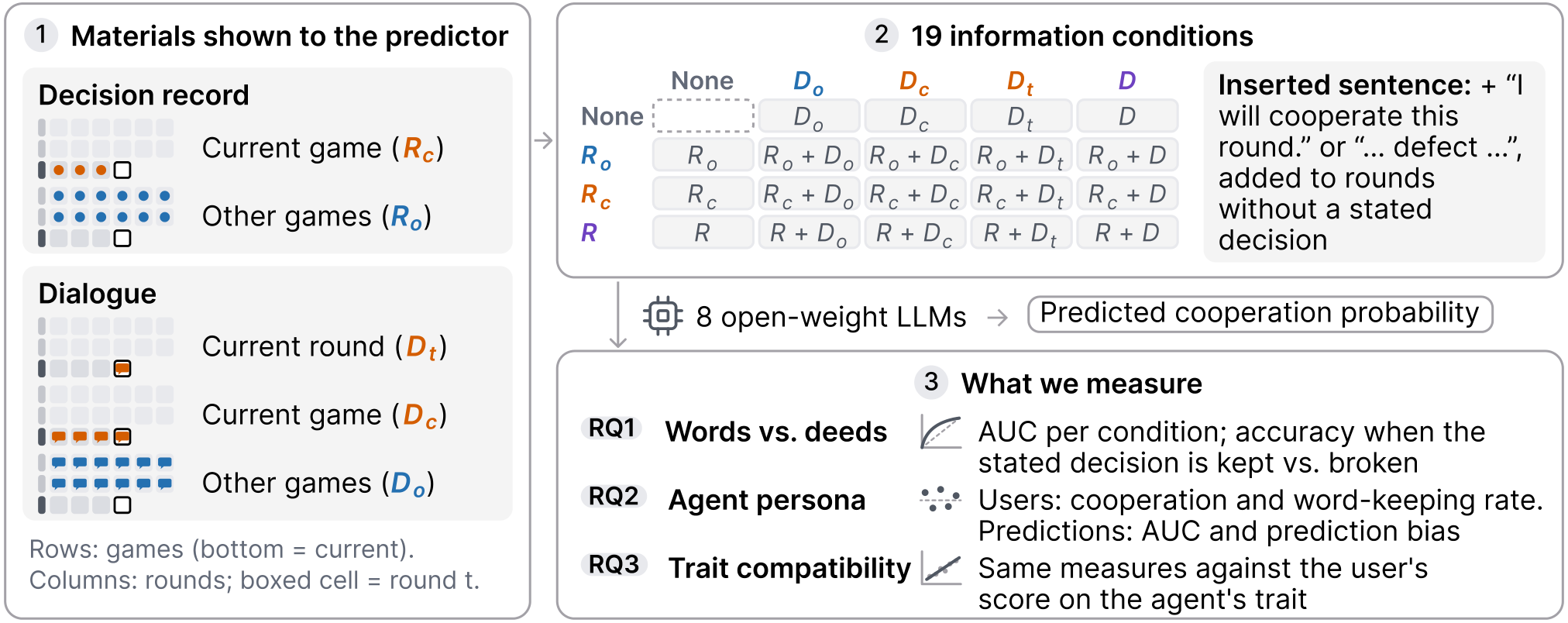
The predictors received information recorded before each decision: earlier actions by both players, dialogue, or combinations of the two. Nineteen information conditions tested what each source added.
| Analysis | Games | Rounds | Users |
|---|---|---|---|
| Human behavior across agents | 1–5 | 1,260 | 42 |
| Predictions and matched behavior | 2–5 | 1,008 | 42 |
 Opens in a new tab.
History ranked decisions well
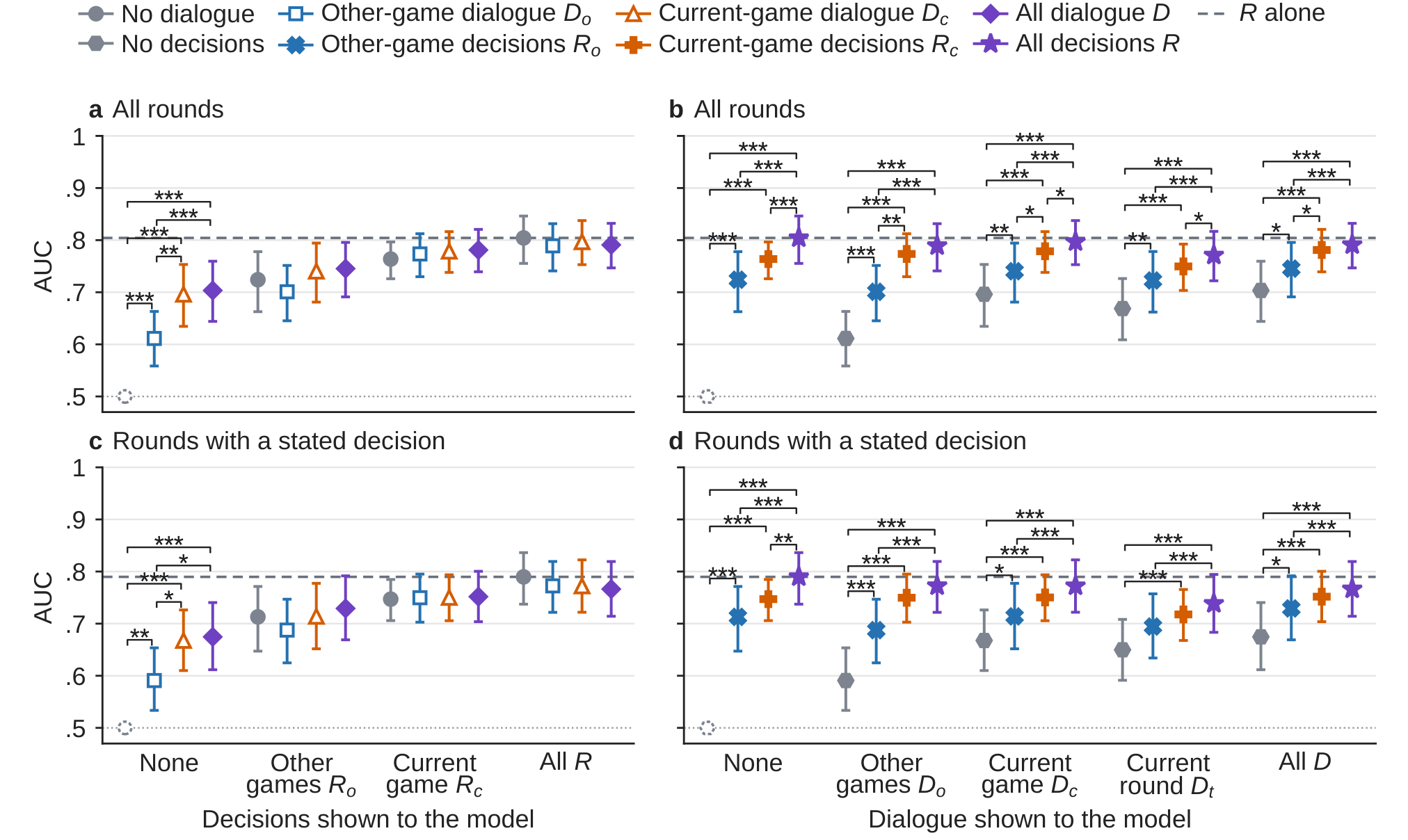
Earlier decisions reached AUC .80, compared with .70 for dialogue alone and .79 for both. Adding decision records improved ranking across all 12 tested comparisons; adding dialogue to an available record brought no detectable gain. AUC measures whether cooperation ranks above defection, rather than the percentage of correct answers.
 Opens in a new tab.
Similar accuracy concealed different errors
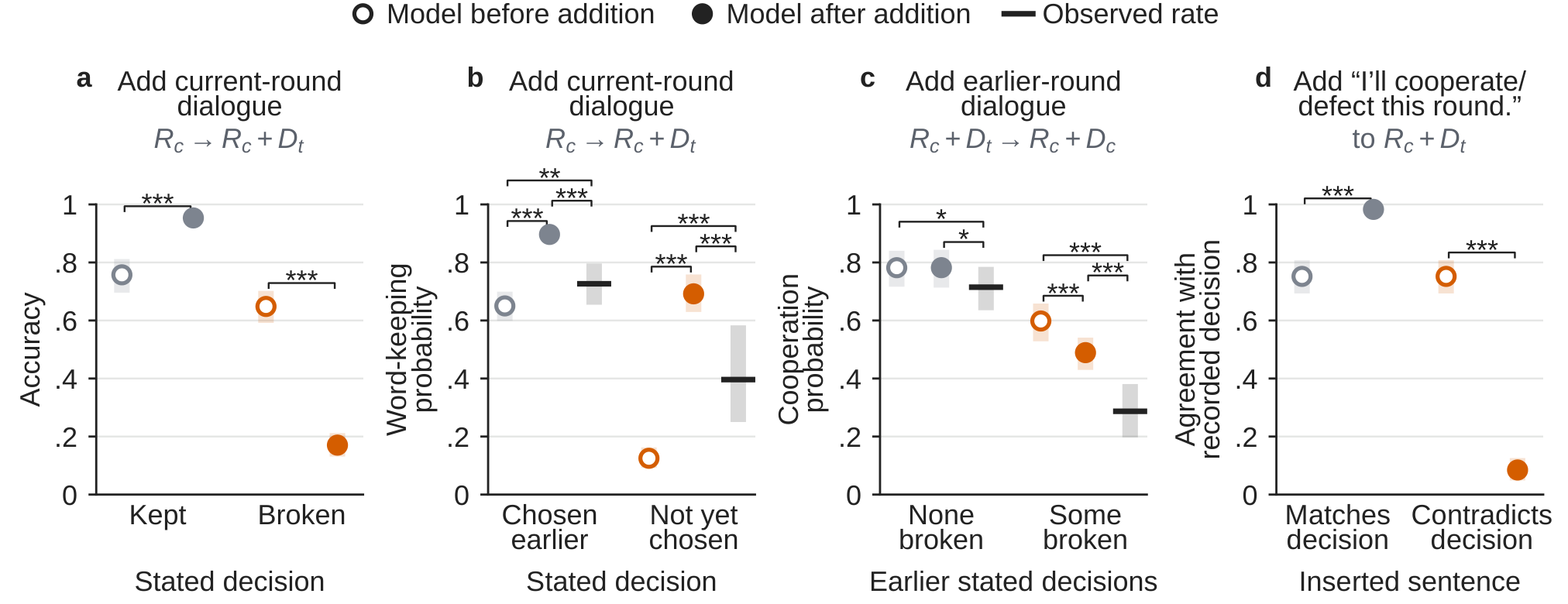
Adding the current dialogue barely changed accuracy on stated-decision rounds, from .73 to .74. It raised accuracy from .76 to .95 on 470 kept statements, but lowered it from .65 to .17 on 176 broken statements. Both changes were significant after correction.
 Opens in a new tab.
When a statement named an action the user had not yet chosen in that game, predicted word-keeping rose from .13 to .69; the observed rate was .40 (53 rounds from 20 users). Earlier broken statements were only partly used: adding earlier dialogue lowered predicted cooperation from .60 to .49, still above the observed .29.
One inserted sentence moved agreement with the recorded decision from .75 to .98 when it matched that decision, and to .08 when it contradicted it. This tests how strongly the forecast responds to a statement, without showing that the statement changes human behavior.
People varied more with their counterpart
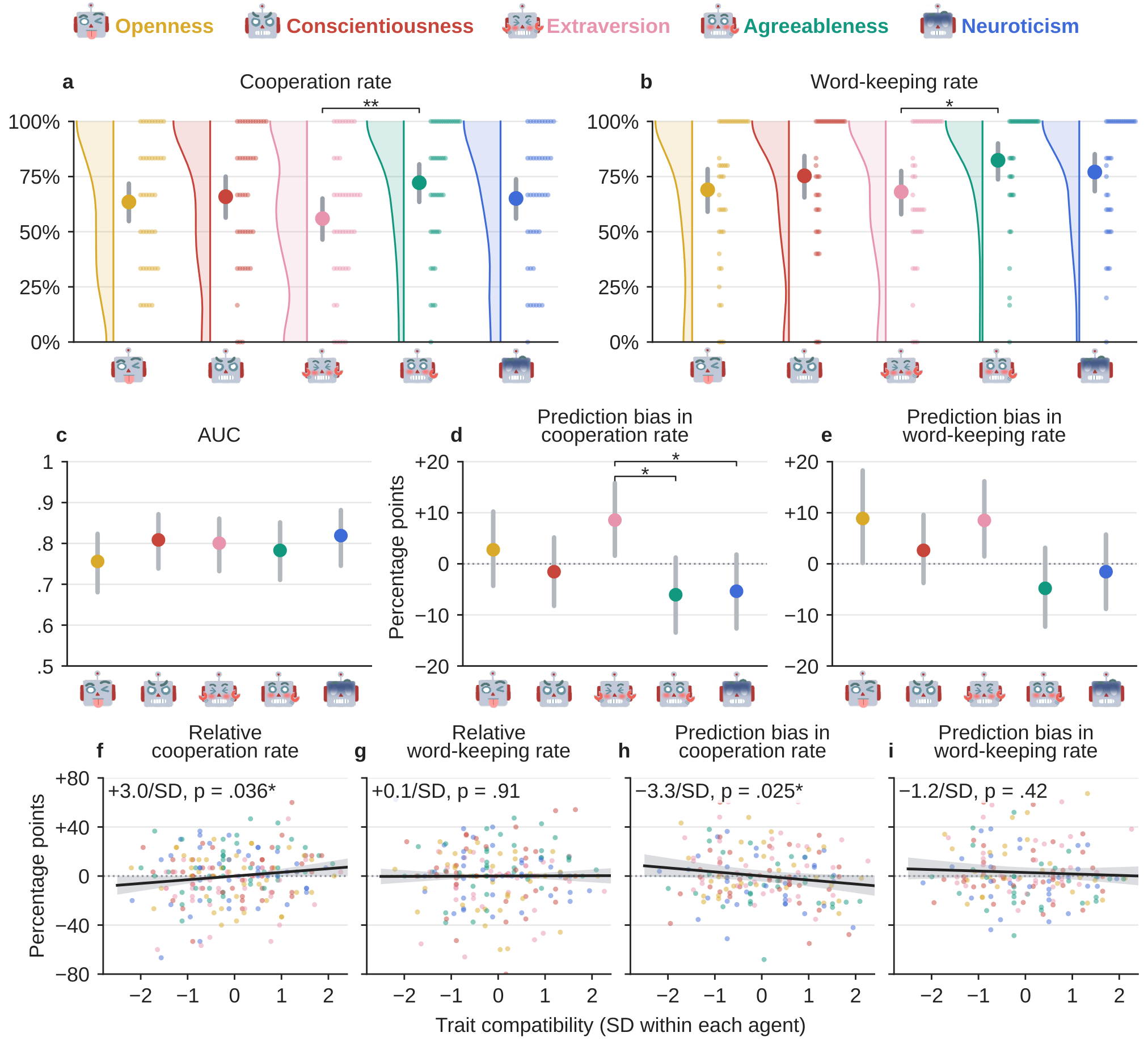
Across all five games, people cooperated more with the Agreeableness than Extraversion agent (72.2% versus 56.0%) and kept more statements (82.4% versus 68.1%). Other persona pairs did not differ reliably after correction. How often people stated a decision also showed no detectable persona difference.
On the matched prediction rounds, the same agents elicited 70.6% versus 54.5% cooperation, but predicted cooperation was 64.5% versus 63.1%. AUC did not differ reliably by persona. The near-zero pooled cooperation bias concealed a 14.6-point bias difference between these two agents.
 Opens in a new tab.
Compatibility mattered for cooperation
Compatibility means the user’s score on the trait expressed by the agent. Relative cooperation rose by 3.0 percentage points per standard deviation of compatibility, while prediction bias fell by 3.3 points. Neither word-keeping nor its prediction bias showed a detectable compatibility relationship. These trait analyses were exploratory and uncorrected.
Link statements to what happened next
A supplementary evaluation added an explicit record of what the user had said and then chosen in earlier rounds. This reduced the two overestimates, although cooperation after an earlier broken statement remained above the observed rate.
| Prediction | Before record | With record | Observed |
|---|---|---|---|
| Keeping a statement of an action not yet chosen | .69 | .40 | .40 |
| Cooperating after an earlier broken statement | .60 | .40 | .29 |
Providing personality scores also helped: the compatibility-related bias slope changed from −3.3 to −2.5 points per standard deviation. Its remaining interval included zero. Both the full Big Five scores and the single compatibility score produced similar improvements.
The study used short, low-stakes games with Chinese university students. Persona prompts changed both agents’ language and actions, so their effects cannot be isolated here. The results concern these offline forecasts.
Models, analysis subsets and statistical details
Game, predictors and inference
Mutual cooperation earned two points each. Unilateral defection earned three for the defector and zero for the cooperator; mutual defection earned zero. The agent’s decision was revealed only after the user’s.
The eight instruction-tuned predictors were Qwen3.5-9B, Qwen3.8-27B, Gemma-4-12B, Gemma-4-31B, Seed-OSS-36B, GLM-4-32B, Ministral-3-14B, Olmo-3.1-32B. They ran locally with Chinese prompts, zero-shot and with reasoning disabled. Cooperation-versus-defection log-odds were averaged across both answer-letter orders before conversion to probabilities. Results summarize the eight predictors. The five interaction agents all used GPT-4o.
Uncertainty used 50,000 user-bootstrap draws, retaining each sampled user’s games and rounds together. Displayed comparison families used Holm correction. A model difference counted as significant only with the same sign under both letter orders. Compatibility slopes pooled agents and were not multiplicity-corrected.
Statement labels and analysis subsets
Two researchers labeled dialogue without seeing the later decision. Agreement was κ = .97 for cooperation, defection and no stated decision. Prediction rounds included 646 stated decisions from 41 users: 470 kept and 176 broken. Analyses requiring an earlier round excluded round 1. The not-yet-chosen group contained 53 rounds from 20 users; the sentence-insertion comparison used 308 rounds from 40 users with no stated decision.
Ranking and statement effects
AUC was .80 [.76, .85] for all decision records, .70 [.64, .76] for all dialogue, and .79 [.75, .83] for both. Adding records raised AUC in 12 of 12 all-round comparisons and 11 of 12 stated-decision comparisons. Across nonempty record levels, dialogue conditions differed in 0 of 18 comparisons in each subset.
Current dialogue changed accuracy by +.20 [.15, .25] for kept statements and −.48 [−.52, −.44] for broken ones (both corrected p < .001). For previously chosen stated actions, predicted word-keeping rose from .65 to .90 against observed .73. For an action not yet chosen, observed word-keeping was .40 [.25, .58]; the forecast moved from below to above that rate (both corrected p < .001).
Relative to swapping the user’s previous decision in the prompt, an inserted cooperation statement changed prediction log-odds by a mean ratio of 1.34 across models. The corresponding behavioral-regression coefficient ratio was .35 [.11, .68]; the difference was .99 [.65, 1.38] (corrected p < .001). The first ratio measures model input sensitivity; the second measures association in recorded human behavior.
Persona and compatibility
All-game Agreeableness–Extraversion differences were +16.3 points [6.7, 25.8] for cooperation (corrected p = .008) and +14.3 [4.7, 24.5] for word-keeping (p = .022). On prediction rounds, cooperation bias differed between Extraversion and Agreeableness (14.6 points, p = .013) and Extraversion and Neuroticism (13.9, p = .018). No persona’s individual bias differed from zero after correction. The Extraversion–Agreeableness word-keeping bias contrast was nonsignificant (p = .057); pooled cooperation bias was −0.1 [−4.6, 4.4] points.
Relative cooperation increased by 3.0 points/SD [0.2, 6.0] (p = .036); relative word-keeping did not (+0.1, p = .91). Cooperation-bias slope was −3.3 [−6.4, −0.4] (p = .025), whereas word-keeping-bias slope was −1.2 (p = .42). On matched prediction rounds, observed cooperation rose by 4.1 points/SD and predicted cooperation by 0.8.
Supplementary prompt information
Adding Big Five scores changed the bias slope to −2.5 [−5.3, 0.3] (p = .082), an improvement of 0.9 [0.2, 1.5] (p = .005). Adding the compatibility score changed it to −2.5 [−5.6, 0.4] (p = .090), an improvement of 0.8 [0.4, 1.2] (p < .001). The two additions did not differ (p = .83).
For the two groups in the said/did table, adding earlier dialogue instead of the explicit record produced probabilities of .60 and .49. Both exceeded the record’s .40 (corrected p < .001). In groups with a previously chosen stated action or no earlier broken statement, the record changed predictions by less than .05. These supplementary conditions are reported in Section 5.1 and Appendices C–D of the preprint.