Community environments and everyday well-being
How are community environments associated with residents’ well-being and the way they evaluate their own community?
Manuscript submitted
- Institution
- Lifedu Educational Technology Co., Ltd.
- Supervision
- Dr. Ze Geng, Principal Investigator
I preprocessed electroencephalography (EEG) recordings, extracted centroparietal positivity (CPP) slopes, and fitted and compared behavioral models for this collaborative study.
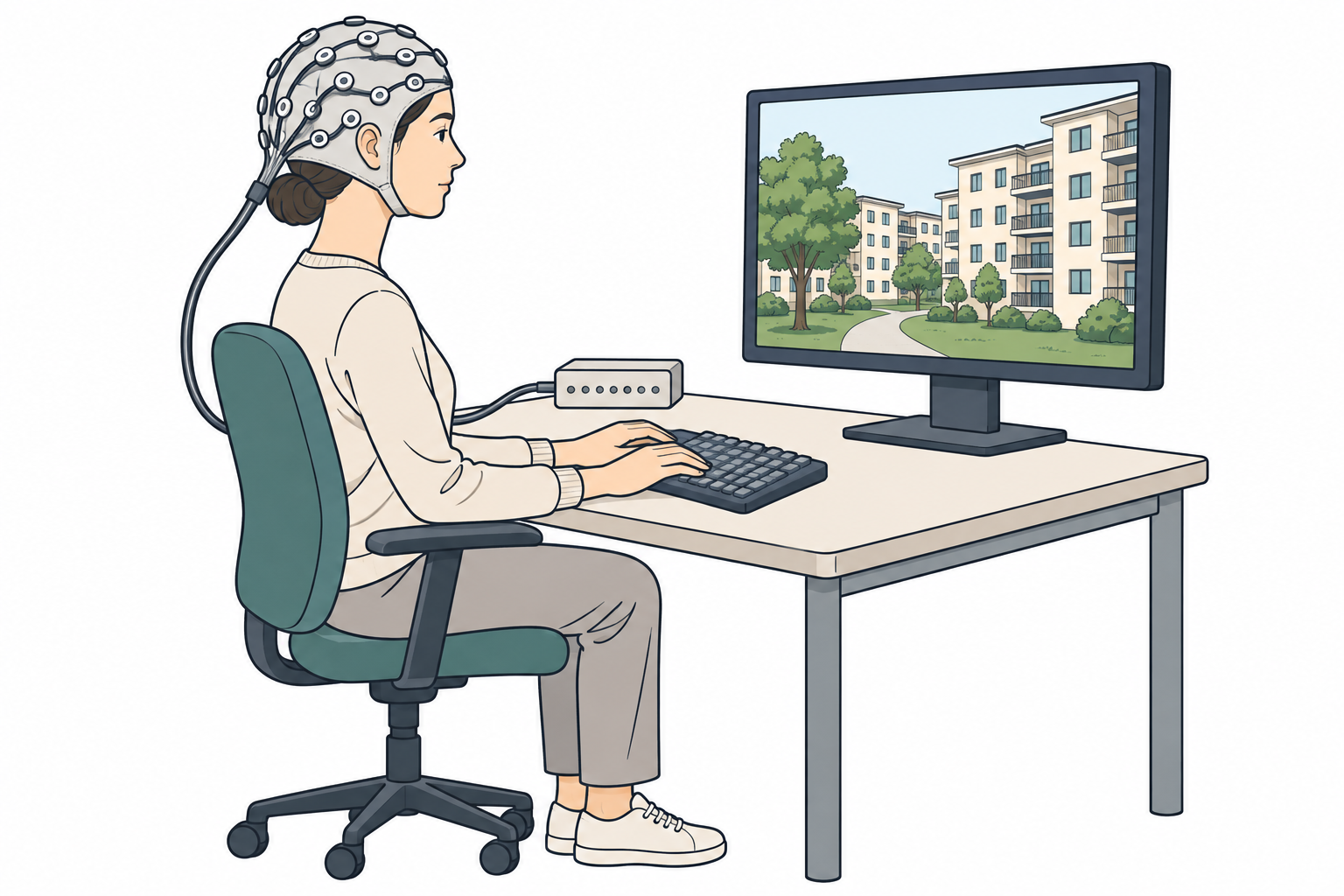 Opens in a new tab.
- Community imageClassify and respond
- pleasantThen an affective wordClassify and respond
Mapping 1
Mapping 2
From recordings to a decision model
Trial-level CPP slope
Derived from centroparietal EEG
CPP included in the drift-rate specification
Evidence accumulation
ChoiceResponse time
Observations for model fitting
Schematic accumulation paths
I retained valid error responses for decision modeling.
Model fitting and comparison
CPP slopes were extracted from trial-level EEG averaged across Pz, Cz, CP1 and CP2. Models were fitted using aggregate maximum-likelihood estimation in PyDDM and compared using BIC. CPP slope was a measured covariate; drift rate was a model parameter. The model separated accumulation from nondecision time, so boundary-crossing time alone is not the full response time.
Error trials were excluded from response-time and D-score summaries, while valid error choices were retained for decision modeling.
Further study details and results will be added after publication.